

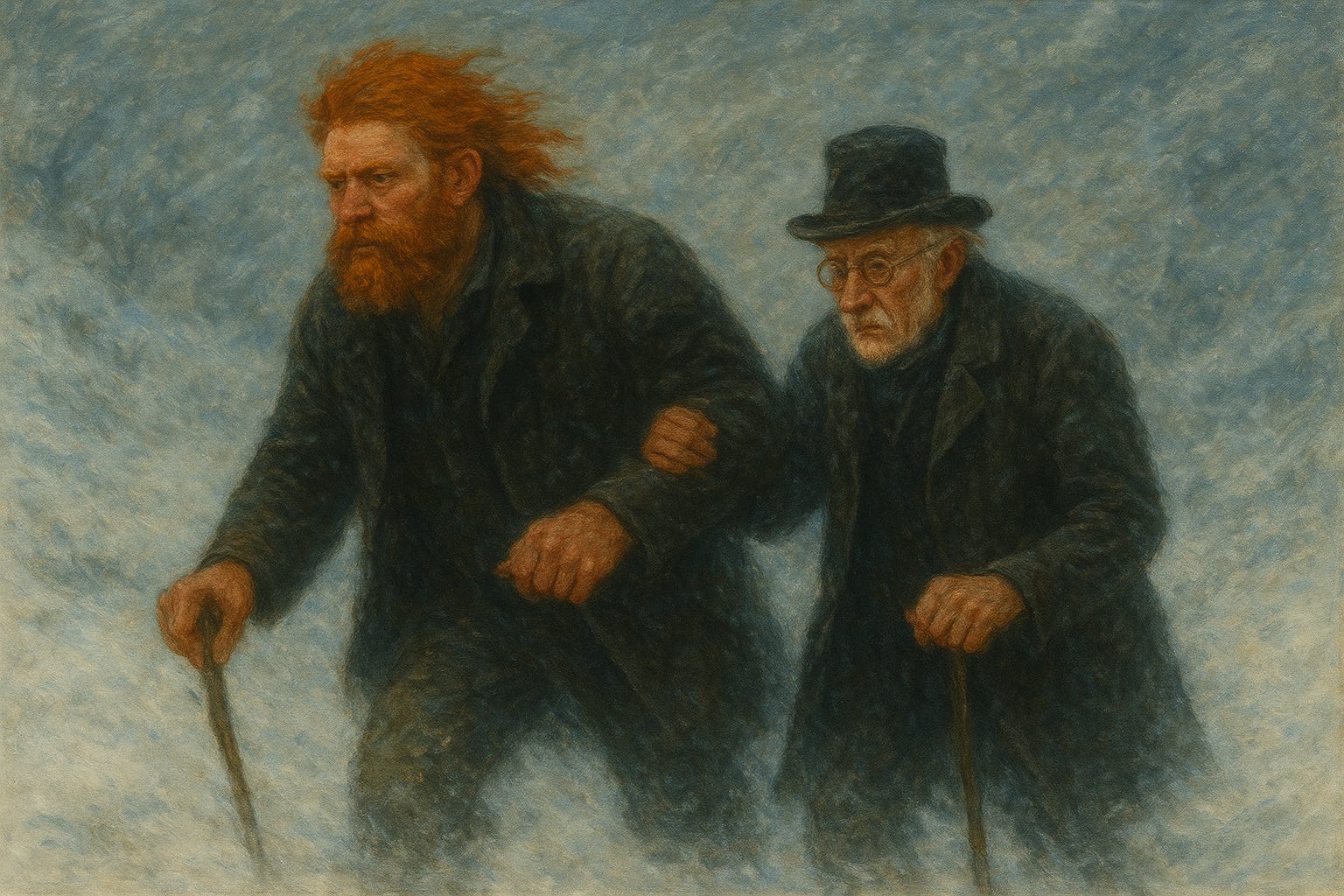
This story begins nearly half a century ago. The world has momentarily gone quiet, swaddled in a blanket of snow, thicker than any in living memory. A young couple have recently moved to a little village in the heart of the Dorset countryside. They are still strangers to the hedgerows older than houses and have yet to explore the footpaths worn by generations. Things have not gone to plan as they seldom do in life and in the chaos of moving and pregnancy. Their baby is already two weeks overdue, and now, in the deep grip of the blizzard, he chooses this ill-fated moment to arrive.
Telephones in these times are those fixed things that cling to walls or sit on tables like obedient servants rather than the modern day tyrants of attention we can’t be without. Connected by wires they have fallen mute with the weight of the snow and the force of the storm. So now word is carried as it was before them by boot and breath through snow drifts higher than window sills.
In this way the news finds itself at the door of John Diggens. A man built like a shire horse with flame red hair and thick beard coarse as copper wool. Behind this imposing exterior is a gentle soft spoken man who would cradle a bird with a broken wing with the care and the delicacy of a child holding a soap bubble. As the news settles in and around him he turns his back on his warm place by the hearth, and says farewell to his black Labrador Merlin who is curled up comfortably on the hearth, far too comfortable to drag out into the eye of this storm.
John’s is a soul tuned to the quiet language of animals and seasons. A man of few words and wisdom borne from communion with the land. Without pause or question he lifts up the burden of this news on his broad shoulders pulls his coat around him and steps out into the blizzard because if not him then who? Snow swallows the tracks behind him as he vanishes into the white, guided by instinct and the memory of the paths and bridleways etched in his mind. He came from travelling stock and hears the song of the land even through the snow and the storm.
Others would later recount his journey in warm pubs and kitchens long after the ice has melted from his beard, but he himself would never speak of it, not then, not decades later. He was not the sort of hero we see exploding onto the silver screen with noise, violence, questionable moral certainty and swagger. He was the quiet unassuming kind; the kind who helps simply because help is needed, who battles his own dark demons and inner storms, and still chooses compassionate action over retreat.
Eventually he reaches the retired doctor in the neighbouring village. And he finds an old, kind man who has hung up his stethoscope to escape the ghosts of grief and responsibility. The doctor’s aching joints protest as he rises from his seat by the fire to answer the door. The second he opens the door the storm rushes in, as if to escape its own chill, and he shivers as the biting cold gnaws at his tired bones.
Even before the words have been uttered the doctor knows he is being called. As John speaks his soft, short sentences the doctor’s eyes fall to his medical bag, placed on the stand years before and ready now as if the fates always knew this day would come. He knows the odds and he knows this was exactly the type of situation he had wanted nothing more to do with. Tragedy in this situation is the cruellest kind; a life ending before it has even begun. Yet he was a man bound by an oath. An oath made at a time when oaths were as strong as English Oak. And so shielded by his companion’s broad shoulders he steps out into the merciless weather, his boots sinking into snow that seems determined to swallow him and part of him hoped it might.
Their journey is a silent sombre procession against the storm both feeling the fear of what they might find on their arrival rising like cold sick in the back of their throats. This feels like a day built for tragedy.
And unbeknownst to them while they are still journeying, a helicopter from the nearby county hospital attempts to land. Some would say, as the story is retold over the years, that the newly created gods of medics and modern medicine, fashioned in a world losing faith, had tried descending from the heavens. But the old order, the gods and goddesses of nature had turned them away with a cold disdain. There would be no hospital, no sterile safety of white lights and instruments. This birth, like births centuries before, would happen at home, without medication, gas or epidural. Instead it would rely on human hands, the fates, and the old, unforgiving and most demanding work of all, labour.
When the doctor arrives bitten by the cold he gratefully stumbles inside the warmth of the house eager to feel the sensation return to his feet and hands. The father nervously greets him not wanting to hurry him, such is the deference we give doctors even in crisis, but unable to hide his fear and the urgency.
Upstairs, in the bedroom the doctor sees the concerned midwife and a mother who has laboured through hours that stretched and folded into one another. The day has waned, and the light is thinning like the strength inside her. The baby’s heartbeat, a sound once strong and certain, has grown faint, like a memory almost forgotten.
He knows as she fights wave after wave of pain, nothing to numb her, nothing to ease her, only determination and love to keep her strong, that she does not have much left to give. This is the scene he had feared and the one he had hoped with retirement he had finally freed himself of ever encountering. Mother and child are losing ground to death’s icy grip.
Banished downstairs, the father paces in the kitchen. A quiet man, a man of medicine himself but now rendered irrelevant, he too knows what is at stake. His steps carve a groove into the kitchen floor, each one a silent prayer, each one a memory of loss, each one a fear he barely has the language to name. His father had died when he was boy and his mother as he became a man. He had lost the family of his birth and now in birth he might lose the family he has created. He knows enough to know how serious this situation is. Naturally pessimistic he is at the point of despair. The fates have always sided against him and he knows with certainty they will again now. He saw the concern on the doctor’s face.
Upstairs, the heartbeat inside her, fades like sand falling through an hourglass. The midwife’s eyes betraying what her mouth would not: the child is slipping away.
The retired doctor, hands trembling from age and dread, presses the cold face of his stethoscope against the mother’s belly again and again. Hope thinning, breath slowing. Tentatively between the exhausting bouts of pushing his stethoscope roams her belly as the mother collapses back in pain and exhaustion to steel herself once more. This time though the movement of his hands is ever so slightly more frantic, the search a little more urgent and then he stops.
Silence shrieks through him.
When he finally finds the strength to utter the words, his trembling voice is the soft breaking of something tender:
“I’m afraid” he said softly, as though volume might shatter the fragile air, “your baby is gone, the heart is no longer beating. We must do everything we can to keep you safe.”
The words fall like snow: quiet, heavy, irreversible. The mother’s face crumples and threatens to shatter, scrunching up as if to keep the terrible horror of the situation from getting in. But it slips through her tired depleted defences and the icy hand of grief presses its thumb against her heart.
One stopped heart breaks many.
But when hearts break, they open. And in this breaking something moved into the opening in her. Something ancient. Something she would never speak aloud, not even years later. It found a home in her breaking heart and it settled
Slowly with great effort she lifts her head, eyes steady, filled not with denial but with a calm, compassionate certainty.
“My boy is alive,” she says.
“And I need you to help me bring him into this world.”
The doctor does not argue. He does not meet her certainty with science or pity. He does not lift the defensive smile of the confident unbeliever. He simply nods, because something in her voice, whether magic or madness, left no room for argument and more than anything right now he wants to believe her. He wants to be the kid who believed in magic and to shake off the cynical adult that knows all too well the pain that lies ahead.
So with no medication, no instruments beyond the bare essentials, and the storm howling outside like an old god impatient for an ending, she pushes. Against the fates, against the odds and against the fabric of reality. She grips the midwife’s hand hard enough to make her bones whisper and she lets out a keening roar that shakes the quiet husband downstairs, rooting him mid-step stranded in terror..
And finally the bloody, silent mess of a baby is thrust into a world that still was not ready to receive it. A small sorry pile of flesh, limp and lifeless. The world stops on its axis, nothing breathes.
The midwife lifts the small motionless form, yellowish fluid dripping from his lips and slaps him with all the gentle ferocity hope could muster.
Still nothing, the horror of the moment echoing with the sound of the slap around the room and reverberating in the assembled souls. Still no-one breathes but it seems more desperate now, hope fading with the dying light of the day. Again she slaps a little harder than she had intended fueled by urgency and her own desperate need for this to not be how it ends. But fate has no care for the needs of mortals.
Then what sounds like a sputter but could just be air escaping as life flees a corpse, perhaps a shudder or just the midwife’s shaking rippling through the fragile form, and finally
a cry that rips through the world with the force of a second storm.
Primal, and undeniable.
The room exhales. Tears, relief and disbelief mingle with steam and winter breath.
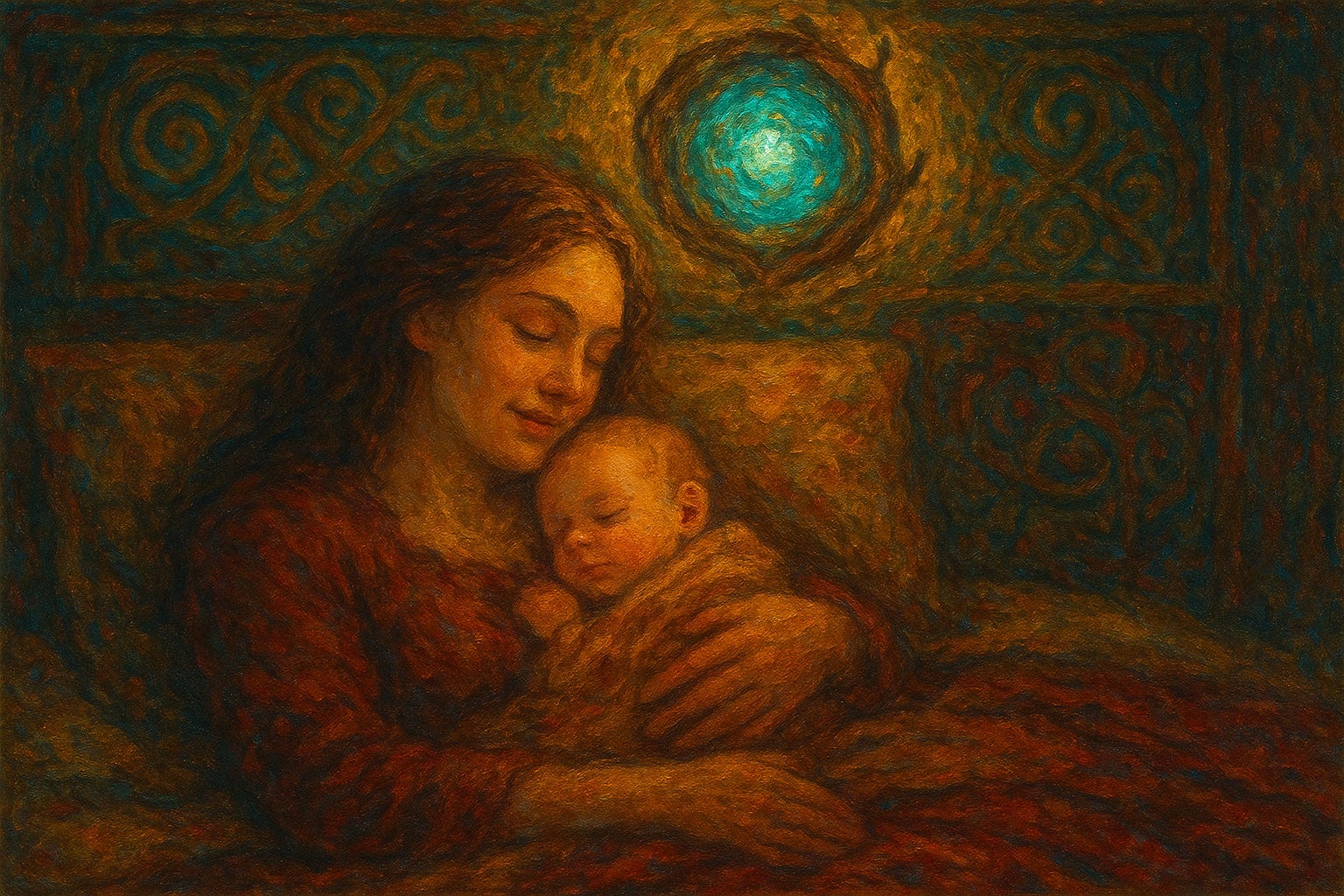
The umbilical cord is cut with kitchen scissors, and the new-born swaddled and warm, safe now, is placed on his mother’s chest, where her tears drop onto his cheeks like holy water.
The father climbs the stairs, eyes raw with terror and hope, and nervously opens the door peering round and almost crumpling when he sees the family he so nearly lost. They lay together in the quiet aftermath, exhausted, astonished. One of them thanks God. The other thanks fate.
Years later when the boy is no longer small but not yet a man he will stand in that same bedroom with the same dresser and this time the dim light of January will be seeping in through that same window. And as the world recovers from the celebrations of a new year, still abuzz with promise and possibility, he will lay his head on his mother’s chest searching for the sound that had once called him into life. And he will hear nothing but a silence that will echo through him. She will leave the world in the exact place she had defied death and fought him into being.
Full circle.
Beginning folded into ending.
Birth stitched to farewell.
In the years to come in his bright moments he will wonder whether he had been spared for something extraordinary.
In darker moments he will question whether he had stolen life from a world that meant him to return to the quiet.
But eventually he will see he had been loved into existence. His mother had fought for him. Not with medicine, not with logic, but with a belief fierce enough to force life back into a stilled heart.
And although she is no longer with him he will spend his life searching, not for certainty or answers but for the quiet magic woven through the ordinary world, a magic that can hide in snowstorms and stillness.
Such a powerful and beautiful piece Nick. Wonderful. I'm glad you made it.